Humanism
The Friendship That Leaves No Room to Breathe
17 September 2026





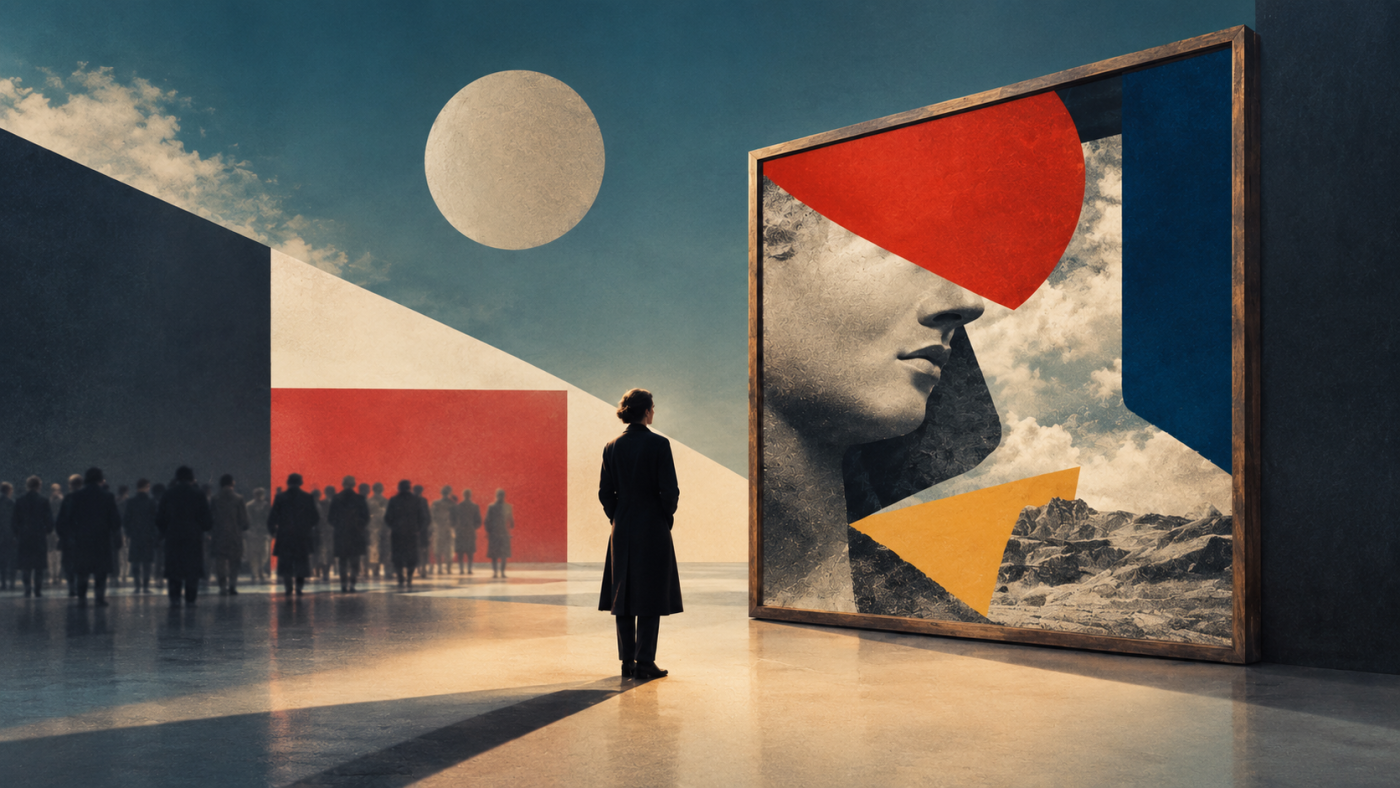
Avant-garde art first provokes bewilderment, sometimes even irritation, and only later reveals that it opened the way for what we now call the canon. It often appears where familiar ways of thinking end, which is why its creators remain misunderstood for so long. Without their courage, would we have so many works that changed culture and the way we experience it?
The word “avant-garde” comes from French and literally means “advance guard.” In its original military sense, it referred to the unit moving at the head of a column, clearing the way for the rest of the forces. That metaphor perfectly captures the spirit of the artistic avant-garde: a group of pioneers exploring new territories in art and culture.
Avant-garde artists emerged at the beginning of the 20th century, rejecting existing styles and canons in order to create their own language of cultural expression. The movement flourished after World War I. That was when movements such as Cubism, Futurism, Surrealism, and Expressionism appeared, bringing innovative techniques and fresh ideas.
Today, the term “avant-garde” is used in a broader context. We speak, for instance, of avant-garde music, literature, or other forms of art that move beyond what is already familiar and resist easy classification. Avant-garde art sets new trends and inspires others.
In Poland, Krzysztof Penderecki is a widely recognized name. Far fewer people, however, know the composer Zbigniew Bargielski, who creates musical worlds that reach far beyond the familiar. His extraordinary, deeply affecting music has slowly been making its way into the canon, although it reached a masterly level long ago.
The Polish literary avant-garde emerged as a heterogeneous and visibly fragmented phenomenon. It also failed to take deep root in public consciousness, partly because it often operated in fleeting, episodic forms. Material hardship and conflicts with censorship contributed to this: state censorship, church censorship, and moral censorship alike.
We recognize figures such as Jarosław Iwaszkiewicz, Czesław Miłosz, and Stanisław Ignacy Witkiewicz, known as Witkacy. These were writers whose work, years ago, began by slowly filtering into culture as something exploratory and unlike anything else.
But we are only now discovering, and learning to accept, the avant-garde quality of Dorota Masłowska, Sylwia Chutnik, Anna Matysiak, and Grzegorz Wróblewski. The last of these creates poetry, drama, and asemic painting. In Poland, this kind of work remains little known, even though abroad it is winning the hearts of collectors searching for entirely new paths and voices in art.
When Cubism was born, led by Pablo Picasso and Georges Braque, contemporary viewers wondered what it was supposed to be. Why were the figures in the paintings fragmented, bent out of shape, as if they had gone completely mad?
Yet the movement consistently sought to present objects in a fragmentary and simultaneous way, breaking with the traditional perspective of figurative painting. It showed the human being as something far from obvious: full of inner conflicts, striving for wholeness, yet never destined to attain it.
Another important movement was Surrealism. Artists associated with it, such as Salvador Dalí and André Breton, explored the subconscious and the world of dreams in their work.
Psychoanalysis was being born, along with questions about the human soul and life after death. A deeper reflection on human existence began to emerge, one that demanded more than digestion and death. Many questions found no answers. Yet the will to search was so powerful that painting expanded the contexts and meanings of art.
Abstraction also appeared as an important avant-garde movement, represented by artists such as Wassily Kandinsky and Piet Mondrian. These artists depicted visible reality as well as psychic reality, exploring shapes and colors in radically new ways.
Expressionism, represented by figures such as Edvard Munch and Egon Schiele, sought to express intense, subjective emotions. It often did so in ways that shocked viewers. At first, people did not know how to classify the unusual brushstrokes, color choices, and distortions.
If not for unusual artists – avant-garde artists, those who go against the current – many commercially successful books and films would never have been created. Lars von Trier, in making films such as Melancholia, drew inspiration from little-known Danish writers who later became known as authors of popular Scandinavian crime fiction. Art needs its advance guard as much as it needs oxygen. In every field.
So what if people do not understand the “new” at first? They do not have to. The new solidifies, becomes familiar, takes over an ever larger area of cultural life, and begins to penetrate social consciousness. This is how great works are made, works that enter the canon of art.
And then they stop being avant-garde, but they never stop being an inspiration. Many such works have been hanging for decades in the finest museums across the globe. Without the avant-garde, the world would not develop. We would be chasing our own tail.
The artist must complicate reality because, as Susan Sontag very accurately observed decades ago, there is a tendency to simplify everything.
– says Grzegorz Wróblewski, a writer, painter, and poet who has long lived in Copenhagen.
The world needs avant-garde artists, often solitary ones, so that they can draw attention to every kind of falsehood, track demagoguery, dispel illusions, and criticize harmful systems. Without that criticism, perhaps we would never have seen the abolition of slavery, paid leave – and we should remember that in the age of the first machines, people worked from morning until night with no possibility of taking time off – women’s rights, or the office of the ombudsman.
Not everything “new” becomes avant-garde, however. Something must happen that seduces critics and the public, that touches the sensitive strings of the viewer, listener, or reader who sees, hears, or reads the “new.” The audience must be moved by its execution and convince others that the emperor really does have clothes. Sometimes this happens only after the artist’s death, when the work begins to live a life of its own, shaping and changing the generations that follow. That is why avant-garde art needs time: what first unsettles us may later become the very language through which culture understands itself.
Read this article in Polish: Najpierw dziwi, potem inspiruje innych. Od szoku do kanonu

A journalist, writer, playwright, painter, and therapist working towards certification. The author of 9 books, including Jak odzyskać duszę, Gdy nadwrażliwość wystawia rachunki. Czterdzieści dwa listy o miłości, życiu i śmierci, co-written with philosopher Professor Lech Witkowski, and Miłość w Ejlacie, published by PIW. A graduate in Political Science from Nicolaus Copernicus University in Toruń, she also completed the European Journalism Programme at the Natolin European Centre and the Academy of Transpersonal Therapy in Warsaw. Her work has appeared in Twórczość, Odra, Czas Literatury, Helikopter, and Dialog.

Truth & Goodness
15 September 2026

Zmień tryb na ciemny