Science
Whose Side Is the Expert On?
30 September 2026





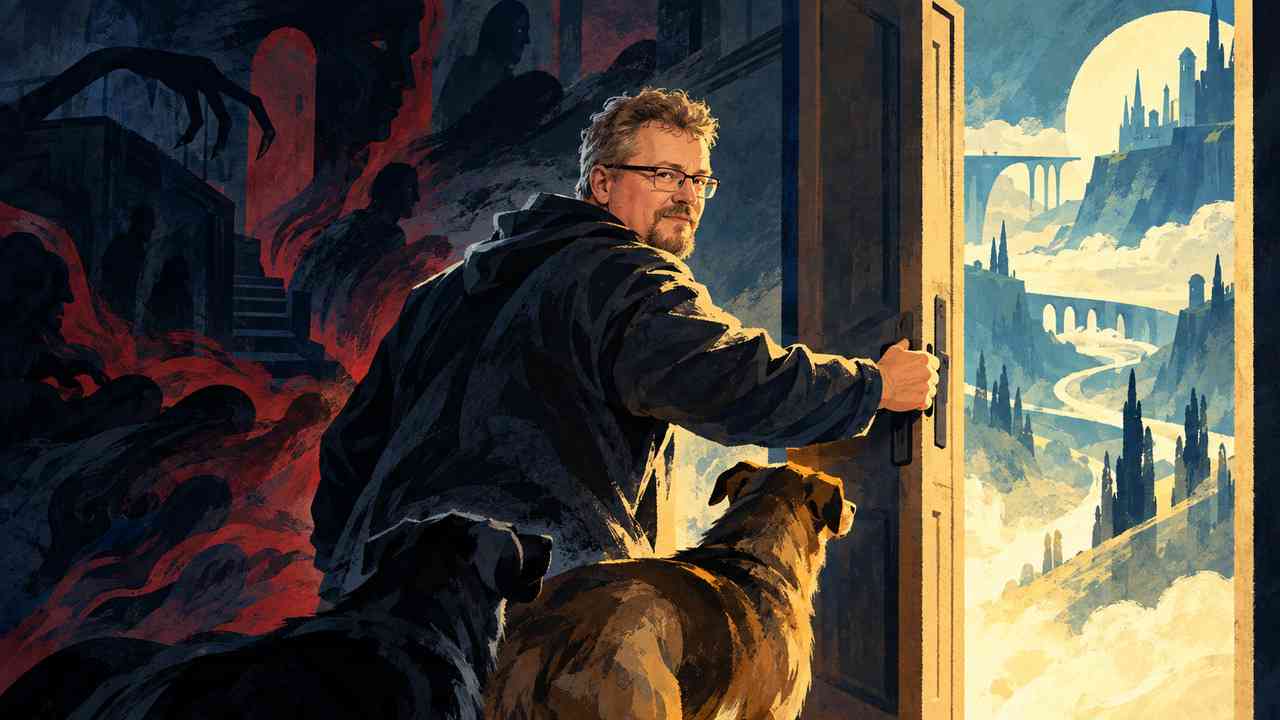
Dreaming has always fascinated artists, scientists, and ordinary people alike. In this essay, Jacek Piekara explores the world of dreams, where nightmares, visions, and strange imaginings can shape how we perceive waking life: warning us, offering advice, and helping us solve problems. It is hardly surprising that these 2 realms—the waking world and the world of dreams—influence each other. Our minds keep working even when they seem to be at rest.
Mystics believed that sleep allowed people to explore other realms of consciousness, perhaps even other worlds. In beliefs concerning witches, people thought that witches could release their souls from their bodies while asleep and travel through the world to harm others.
Some people knew ways to make a witch’s wandering soul lose its way and never return to the body. We know this motif from Slavic beliefs, and it also appears in the greatest treasure of Norse literature, the Poetic Edda. The verse reads:
For the tenth I know,
if I see troll-wives
sporting in air,
I can so operate
that they will forsake
their own forms,
and their own minds.
Whenever the subject of the power of dreams comes up, I always tell a true anecdote about Dmitri Mendeleev, the famous Russian chemist who devised the periodic table of elements. As you probably remember from school, the periodic table looks like a board with cards arranged on it. Each card – there are currently 118 – represents an element.
In Mendeleev’s day, the table looked somewhat different from the one we use today. Another physicist later worked out its final form, and not all the elements had yet been discovered. Interestingly, though, Mendeleev predicted their discovery and even described their properties. But what does any of this have to do with dreams? In an interview, someone asked Mendeleev how he had created his periodic table. Mendeleev replied that the entire table had come to him in a dream. Exactly as it was. Down to the last detail.
The astonished journalist asked, “So it was that simple?” Mendeleev replied, “Yes, sir, but I had spent 25 years working on it beforehand.” And that is the explanation. Mendeleev already had all the pieces in his head. He simply needed to put them in order, and his mind did that while he slept.
Although my own achievements in dreams have never been as spectacular as Mendeleev’s, on several occasions I have found solutions to plot problems in the books I was writing while dreaming. Sometimes a dream has even inspired me to tell an entirely new story.
I have spoken to many people who say they never, or almost never, dream. Others say they immediately forget their dreams, or that their dreams are not worth paying attention to: just meaningless scraps of imagery. I must admit that my experience has been quite different. Since childhood, I have had highly elaborate, almost cinematic dreams.
Of course, not every dream was like that. But they came often enough for me to look forward with curiosity to whatever the next night might bring. I have had dreams that unfolded in episodes over several consecutive nights. I have also had dreams whose course I could control to some extent, although that was never easy. My dreams were often intricate, with multiple storylines, sweeping action, and vivid imagery.
Many of you will recognize the kind of dream that leaves you uneasy or frightened, waking drenched in sweat or in a bad mood. One recurring nightmare from my childhood has stayed with me: it is night, and I fall down in the middle of a road. I cannot get up, no matter what I do. With all my strength, I try to crawl toward the edge. Meanwhile, I see the bright headlights of a car approaching at speed. The dream ends abruptly just as the lights reach me.
These were dreams filled with fear, hopelessness, and the feeling that I could not save myself. They featured a familiar nightmare motif: nothing works as it should. Interestingly, the dreams were essentially identical every time, and I never managed to find a way to deal with them.
Later came dreams involving a different kind of threat, this time in my own home. I would see my sliding door slowly opening, even though I knew perfectly well that I was the only person in the house. Worse still, my bedside lamp would begin to flicker erratically before going out altogether, plunging the entire room into darkness. When I tried to turn it on—or reached for another lamp – flipping the switch did nothing. At most, the bulb would flicker briefly, then go dark again.
I learned how to deal with this fairly frequent dream. I found a way to wake myself up and escape it. Then something happened that could have come straight out of a novel or a film: once, I woke from the dream and saw the door slowly opening again! It turned out that I had not woken into the real world at all. I had merely slipped from one dream into another. Well, that was not pleasant…

It is possible to develop the ability to steer the course of a dream and act with a degree of awareness while dreaming. It will not always work, but sometimes it can help us turn our dreams in a more pleasant direction. Let me give you an example. Another threatening dream I used to have involved standing beside a door when the bolt began to slide open. It was a bolt that could only be operated from my side, so it had no business moving on its own!
I look through the peephole and see a family: a father, a mother, and a boy, all trying to get in. They are all giggling. Strangely, the little boy is the most sinister and frightening of them all. It was an unpleasant dream, and it recurred many times. And do you know what I eventually decided to do? Instead of desperately holding the bolt in place to stop it from moving, I flung the door open with a furious roar and charged outside. And what did I discover? There was nobody there!
Whenever that dream returned, I did exactly what had worked the first time, aware that I had found a solution to the problem. Well, the experience bears out the saying that we can overcome our fears only by confronting them.
The world of dreams and nightmares is certainly extraordinary and fascinating. It allows us to push the boundaries of our imagination and sometimes even inspires us. To finish, let me quote a passage from C.S. Lewis’s The Voyage of the Dawn Treader. The crew rescues Lord Rhoop from the Dark Island, “Where Dreams Come True.” When the sailors begin to get excited about being near a place where dreams come true, Lord Rhoop cries out:
That is the sort of talk that brought me here, and I’d better have been drowned or never born. Do you hear what I say? This is where dreams – dreams, do you understand – come to life, come real. Not daydreams: dreams.
Let us wish, then, for a realm where our dreams and aspirations come true, rather than one where we must face our nightmares – although, on the other hand, overcoming nightmares is immensely satisfying!
Read this article in Polish: Po drugiej stronie snu. Jacek Piekara o krainach, które otwierają się nocą


Jacek Piekara: One of Poland's most popular fantasy writers, a journalist, and a columnist. He is the author of the widely acclaimed "Inquisitor Series" (Cykl Inkwizytorski), dozens of books, and numerous short stories. Piekara has also contributed to specialized and popular press, including the magazines Click! and Gambler. In addition to literature, he writes scenarios for computer games and works as a publicist.



Zmień tryb na ciemny