Humanism
What Happens When Winning Stops Being Proof of Worth?
11 October 2026





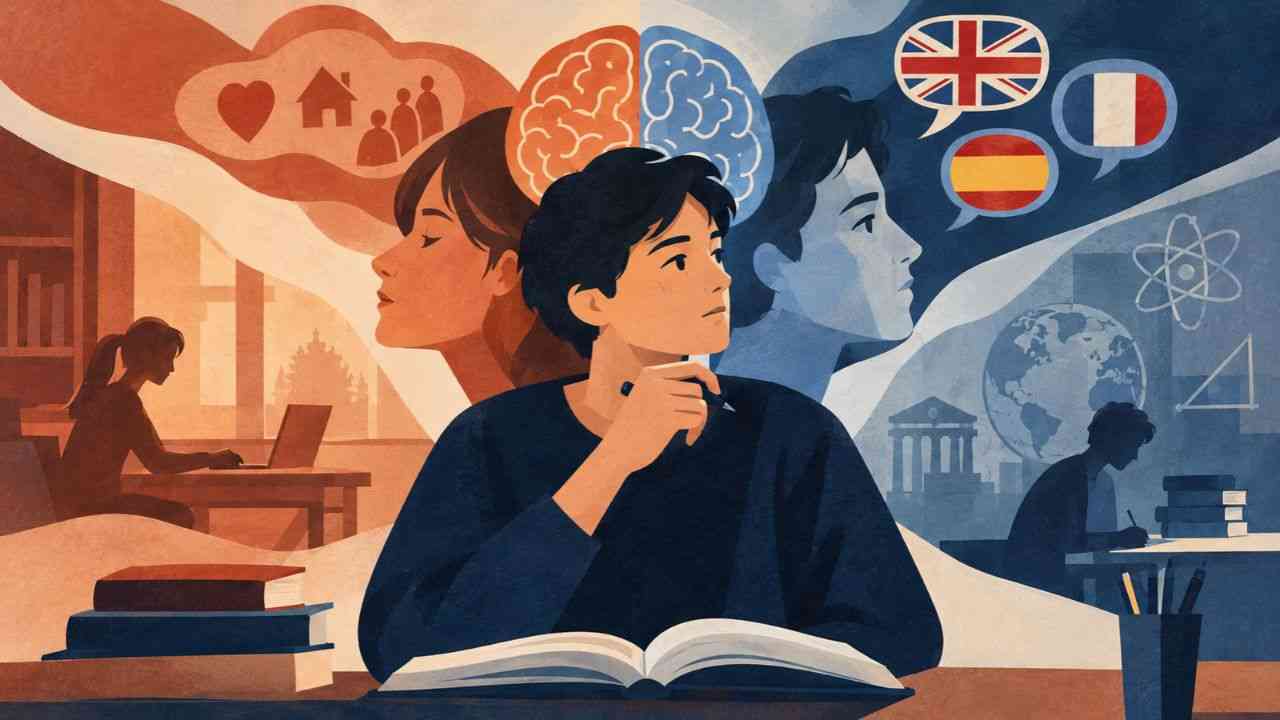
The Brain’s Language Switch When we switch to a foreign language, something subtle—and sometimes profound—can happen. It is not just our vocabulary or the rhythm of our sentences that changes. Our inner landscape may shift too: the pace of our thoughts, how cautiously we respond, and even our sense of identity. Some people feel more […]
When we switch to a foreign language, something subtle—and sometimes profound—can happen. It is not just our vocabulary or the rhythm of our sentences that changes. Our inner landscape may shift too: the pace of our thoughts, how cautiously we respond, and even our sense of identity.
Some people feel more direct when speaking English, cooler and more reserved in French, or more relaxed in Spanish. These are personal experiences rather than fixed properties of the languages themselves. For some, speaking another language brings an exhilarating sense of freedom: it becomes easier to say things that would catch in their throat in their mother tongue. For others, it means a quiet, constant effort—the tiring awareness that their thoughts once again exceed the words available to express them.
The question of who we become when we think in another language no longer belongs exclusively to philosophers and linguists. Today, it has practical implications for hundreds of Polish students in bilingual schools who study chemistry, history, or physics in a language other than their first. We examine how using another language can affect thinking, what this education offers young people, and why it deserves a closer look than simply asking whether it helps them learn vocabulary faster.
In 2012, University of Chicago researchers Boaz Keysar, Sayuri Hayakawa, and Sun Gyu An published experiments that helped launch a series of fascinating discoveries. They presented participants with decisions involving risk, using either their native language or a foreign language. The underlying problems remained the same, but participants using a foreign language showed less susceptibility to certain decision-making biases.
Later research, including a 2014 study by Albert Costa and colleagues, examined classic moral dilemmas. Participants considered the same situations in either their native or a foreign language.
Those experiments found that participants using a foreign language were more likely to make utilitarian choices in certain dilemmas, favoring outcomes that benefited more people. This suggested that language could influence the balance between emotional reactions and the weighing of costs and benefits, although a more utilitarian answer does not necessarily mean more careful or better reasoning.
Researchers call this phenomenon the foreign language effect, and subsequent independent meta-analyses have examined evidence for it. One proposed explanation concerns the different circumstances in which we acquire our languages. We absorb our native language from infancy, surrounded by powerful emotions, family relationships, and early experiences.
Words can acquire strong emotional associations through those experiences. A foreign language, by contrast, is often learned in a classroom, through textbooks or films, without the same early emotional context. Using it can place different demands on our cognitive resources and feel less emotionally charged, potentially creating greater distance from a problem. This varies with proficiency, personal experience, and how the language was learned.
Many bilingual people recognize this experience. In another language, they may find it easier to set a boundary, have a difficult conversation, or name complicated emotions. A foreign language can act like a natural thermostat, slightly lowering the temperature of a disagreement.

This cooling effect, however, has limits. Emotional distance may help us approach an ideological disagreement or reflect on history, but it does not automatically improve reasoning in every domain. A recent study published in the Journal of Cognition examined moral decisions and how people evaluated their own answers. It found no foreign language effect on moral choices in its 2 studies, although language affected aspects of confidence, uncertainty, and reconsideration.
Discussing historical events in English may give students some distance from familiar identity-based narratives and encourage a broader perspective. It does not automatically remove cultural biases. Likewise, solving a system of equations in English still requires the same algebra, now alongside the additional demands of working in another language.
The feeling that we express ourselves differently in another language has a basis in the architecture of human cognition. Working memory has limited capacity. When a student tries to understand a new, complicated definition, their brain performs several operations at once: interpreting its meaning, building a new conceptual framework, and connecting it with existing knowledge.
A foreign language can add another layer of processing: monitoring syntax, finding the right terms, and maintaining grammatical accuracy. Each of these operations draws on the same valuable resource – our attention.
Linguist Jim Cummins’s classic distinction between 2 types of language proficiency helps explain why conversational fluency can be misleading. The first is basic interpersonal communicative skills: the everyday language that allows us to chat comfortably, watch television series, or communicate effectively on vacation. The second is cognitive academic language proficiency, which we need to understand abstract processes such as stoichiometry, orbital hybridization, or quantum physics.
A teenager may speak fluent, witty English during a school break yet still need time to develop the conceptual vocabulary required to understand a biology lesson. Developing full academic proficiency in another language takes years of sustained work. This helps explain a situation encountered in bilingual schools: a student readily uses an English scientific term, but when the same concept appears in Polish on an exam, they need to make a brief conceptual connection between the 2 languages.
Does learning in another language therefore do nothing but slow us down? Certainly not. UCLA psychologist Robert Bjork developed the concept of desirable difficulties: learning conditions that initially require more effort and slow performance, but improve long-term retention and the ability to apply what we have learned.
Reading a demanding scientific text in another language may create opportunities for this kind of active engagement, although difficulty alone does not guarantee better learning. Instead of moving through a paragraph on autopilot, as can sometimes happen in their first language, students may need to pause, unpack a sentence, and actively construct its meaning. This extra effort can encourage deeper processing and help knowledge stay with them longer.
The key, however, is balance. A difficulty becomes desirable and productive when students have the tools to overcome it. With appropriate support, effort can lead to satisfaction and genuine intellectual development.

Bilingual education has considerable potential, and scientific meta-analyses support its language-learning benefits. A review covering more than 214,000 primary school students found that teaching subjects through a foreign language significantly improved language skills, while subject-learning outcomes were comparable on average to those of students in conventional programs. More recent research involving over 52,000 participants also found positive effects on language development, though it did not establish the same conclusion about subject knowledge.
Students in bilingual classes can leave school with strong language skills and opportunities to develop flexibility in how they approach problems. Working across languages can encourage them to consider more than 1 perspective and engage with the wider world. These are educational opportunities, rather than guaranteed outcomes for every graduate.
Experts emphasize that the success of this approach depends on several elements working together: students’ initial language preparation, effective support from teachers, and methods suited to the subject. Studying the humanities, social sciences, and geography in another language can help young people move beyond familiar cultural frameworks and examine global issues from different perspectives. In science subjects, a foreign language becomes a precise tool for scientific communication.
Classroom practice today offers a rich variety of approaches to bilingual learning. Teachers increasingly move flexibly between languages, allowing students to establish a firm understanding of difficult concepts in their first language before discussing them and analyzing sources in English.
Choosing a bilingual class goes beyond a practical educational decision. It can offer sustained practice in cognitive flexibility and reveal how the same problem, expressed in another language, may carry a different weight or feel quite different.
Ultimately, the point is neither uncritical enthusiasm for bilingual education nor a search for hidden dangers. It is awareness. When we understand that another language can create emotional distance while demanding greater concentration, we stop treating it as a magical shortcut. We begin to see what it can offer: another pair of eyes through which to view the world, and a tool that, used thoughtfully, can help us think more calmly, examine ideas more deeply, and gain some distance from our own convictions.
Read this article in Polish: Dwa języki, dwa sposoby myślenia. Co zmienia się w mózgu ucznia?


Content marketing specialist with his heart in journalism and English translations. An active writer for 20 years. Majored in economy. He has authored several non-fiction books, one of which won an award at the Ladek Mountain Festival. Sports, hard rock, and Italian cuisine afficionado.



Zmień tryb na ciemny